
Average PD (Pupillary Distance) for Adults and Children
For adults, the average PD is about 63 mm. Among 3,976 adults surveyed, the mean was 63.4 mm: men averaged 64.7 mm and women averaged 62.3 mm.
- 63.4 mmmean PD across 3,976 adults
- 64.7 mmmen, on average
- 62.3 mmwomen, on average
- 52 to 78 mmfull adult range in the survey
Average Pupil Distance, Male and Female
The US Army ANSUR survey is the source of these figures, with the analysis done by Neil Dodgson at the University of Cambridge. Averages were 64.7 mm for the 1,771 men and 62.3 mm for the 2,205 women. Either group can measure anywhere from 52 mm up.
| Group | People measured | Average PD | Smallest | Largest |
|---|---|---|---|---|
| All adults | 3,976 | 63.4 mm | 52 mm | 78 mm |
| Men | 1,771 | 64.7 mm | 52 mm | 78 mm |
| Women | 2,205 | 62.3 mm | 52 mm | 76 mm |
Adults in the US Army ANSUR survey, taken from Dodgson's analysis of the data.
What Is a Normal PD Range?
For most adults, a single PD falls between 50 and 70 mm, with numbers outside that range being uncommon (Cleveland Clinic). Within the ANSUR data, roughly two out of three adults land between 59.5 and 67.2 mm. If you measured it twice, a value outside the usual range is still yours. Check yours against the PD chart.
Average PD for Children by Age
Through childhood and the teenage years, PD increases (Dodgson, citing Fledelius and Stubgaard). For each age group the table gives the average together with the range.
| Age | Girls, average | Girls, range | Boys, average | Boys, range |
|---|---|---|---|---|
| 5 to 7 years | 54 mm | 48.7 to 59.8 mm | 56.3 mm | 53 to 60.8 mm |
| 8 to 10 years | 57 mm | 52.9 to 62 mm | 58.7 mm | 50.8 to 66 mm |
| 11 to 13 years | 59.5 mm | 52.9 to 66.9 mm | 60.2 mm | 53.8 to 67 mm |
| 14 to 16 years | 61.8 mm | 55.8 to 66.9 mm | 63.3 mm | 56.8 to 70 mm |
| 17 to 19 years | 61.5 mm | 54.8 to 65.9 mm | 65.8 mm | 60.8 to 71.8 mm |
Source tables from Fledelius and Stubgaard 1986, via Dodgson 2004.
How to Measure a Child's PD
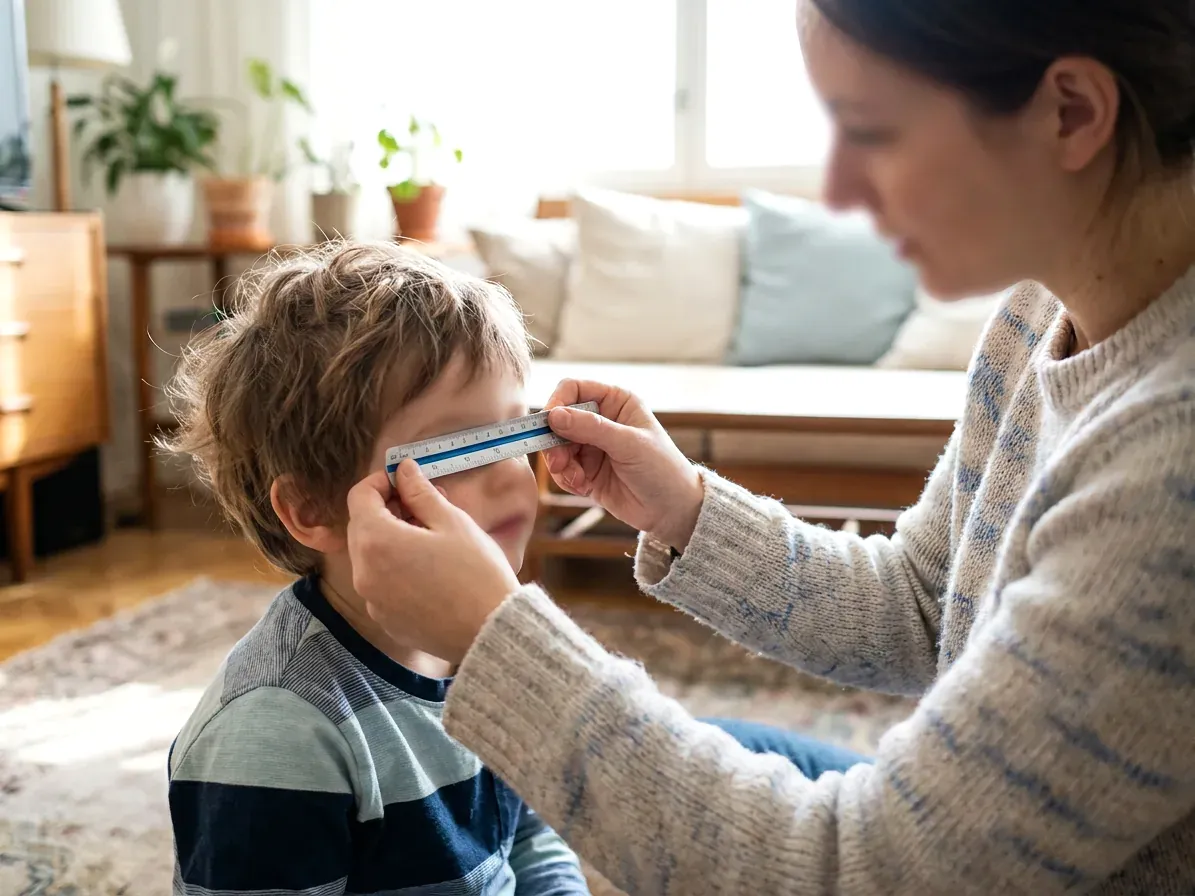
Give the child a distant object to watch, and bring in a helper for the ruler, following the method shown for measuring a child. For anyone older than five, the lowest PD on record is around 40 mm (Dodgson). For a child's glasses, never use an adult average PD.
Does PD Change Over Time or With Age?
It does change in childhood, and barely at all in adults. PD grows from the early years through the late teens; after that it normally holds steady once you reach adulthood (Cleveland Clinic). The ANSUR data reveals only a slight increase between ages 20 and 40. A PD taken during your adult years remains usable for years.
Average PD Questions
For a woman, what is the average PD?
In the ANSUR data covering 2,205 women, the figure is 62.3 mm.
For a man, what is the average PD?
In the ANSUR data covering 1,771 men, the figure is 64.7 mm.
Is it all right to order glasses with the average PD?
For low single vision prescriptions, use it only as a last resort. Your own PD is better, and you can measure it, which takes about a minute.