
Find Your IPD (Interpupillary Distance)
Your IPD, or interpupillary distance, is the space in millimetres between the centres of your pupils. Adults usually fall between 56 and 70 mm, and the figure matches the PD written on a glasses prescription.
- 63.4 mmmean adult IPD, from 3,976 people surveyed
- 56 to 70 mmabout 95% of adults fall here, per Meta
- 1 numberIPD and PD name the same measurement
How to Find Your IPD
For the quickest IPD result, try the camera measurement: put a bank card right under your nose, take one picture, then tap both pupils and the card's ends. With the card known to be 85.60 mm wide, the photo can show measurements in millimetres. You can also use a mm ruler and a mirror; how to measure PD lays out the steps.
Do you already have a pair of glasses? Take the PD from your prescription, and that figure is your IPD. When it appears as two numbers like 31.5/32, add them to get the single value a headset expects.
Interpupillary Distance Meaning
Pupillary means of the pupils, and inter means between. Interpupillary distance, then, is simply the space from one pupil to the other. Opticians call the shorter form PD, while VR headset manufacturers use the name IPD. The two terms describe the same measurement taken while your eyes look at a distant object.
Average IPD for Adults
Across 3,976 adults in the US Army ANSUR survey, IPD spanned 52 to 78 mm, averaging 63.36 mm. The average for men was 64.67 mm, while women came to 62.31 mm (Dodgson 2004). Any value within that band counts as a normal interpupillary distance. Children have lower figures, which the average PD table by age displays.
IPD Measurement for a VR Headset
Your IPD lets a headset place each lens in front of the matching eye. Lenses set too wide or too narrow make the image blurry or doubled, and your eyes soon feel tired.
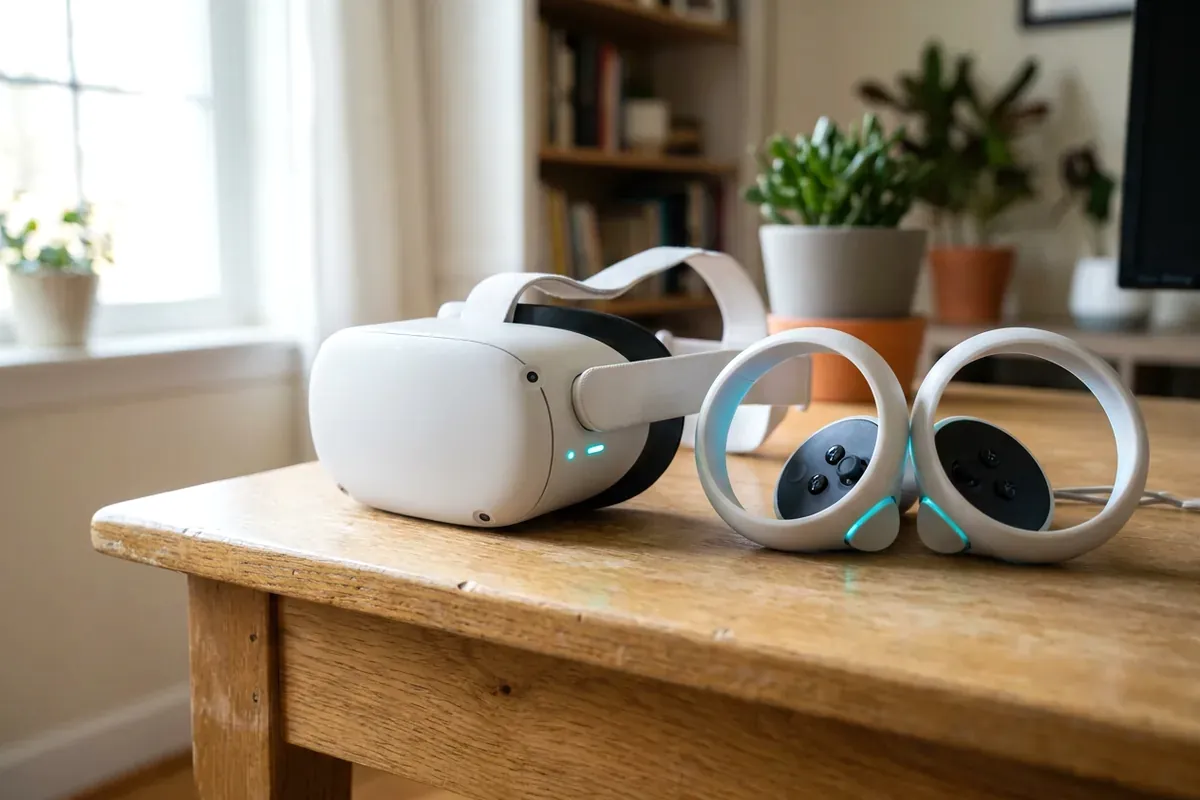
There are three ways a headset can set the gap. A wheel or slider lets you set the lenses anywhere in a range; Meta Quest 3 works this way (53 to 75 mm). Some models give a few fixed positions instead; Quest 2 and Quest 3S, for example, offer 58, 63 and 68 mm. Other headsets measure your eyes on their own: one is Apple Vision Pro, with a 51 to 75 mm range. Compare your figure with the models shown on the IPD VR headset chart.
How to Measure IPD for Quest 3 and Quest 2
First measure your IPD, then adjust the headset to match.
- With Quest 3, wear the headset and rotate the lens spacing wheel until text is sharpest across the entire view.
- For Quest 2 and Quest 3S, pick the closest option among 58, 63 or 68 mm and move the lenses there.
Quest headsets, Meta says, fit an IPD of 56 to 70 mm, and that span includes roughly 95% of adults (Meta support). If your number sits between two steps, test both and stay with the one that looks sharpest.
IPD for Glasses
The same number works for both Glasses and VR. You may also get two numbers from an optician, one for each eye, called a dual PD. A single-wheel headset needs the combined total, while a glasses order form accepts either. Dual PD vs single PD shows how to convert between them.
Do You Need an IPD App?
No. The camera measurement works in the browser on a phone or on a laptop with a webcam, so nothing requires installation and your photo never leaves the device. Some headsets also track your eyes and set the lenses for you on their own.
IPD Questions
Do IPD and PD mean the same thing?
Yes. One measurement in millimetres has two names: interpupillary distance (IPD) and pupillary distance (PD).
What should I do if my IPD falls outside the headset's range?
Push the lenses to the nearest end of the range. A usable picture still appears for most people, though the edges may not look as clear.
What is IPD 63?
With 63 mm between your pupils, you sit right on the adult average. Open the PD chart to see how common each value is.
Is there an online IPD test?
Yes. The camera measurement gives you an IPD test at no cost right in your browser. A bank card is what you need to set the scale.